AI Coding · Review · Updated
GLM Coding Plan Review (2026): What $18 Buys, Where GLM-5.3 Ranks, and Who Should Subscribe
By KGen Research · Published · 14 min read · Some links are affiliate links; we may earn a commission at no extra cost to you. Disclosure
Short answer
The GLM Coding Plan is worth $18 a month as a second model for everyday coding, not as a Claude replacement. On the independent Terminal-Bench 4.0 leaderboard GLM-5.3 solves 41.8% of tasks against 57.9% for Claude Fable 5.1, at roughly half the measured cost, and it is slower. Hands-on reviewers call it the cheapest usable coder; quotas, peak hours and data terms are the trade-offs.
How we researched this
This is a desk review, not a hands-on test: we did not subscribe or run GLM-5.3 ourselves. Prices, quotas and rules were read from Z.ai’s subscribe page, the ZCode site and Z.ai’s documentation and legal pages on October 3, 2026. Benchmark figures come from leaderboards run by parties other than Z.ai (Terminal-Bench, Artificial Analysis, Arena, Vals AI); Z.ai’s own numbers are labeled as vendor-run. Hands-on evidence comes from six 2026 reviews and videos whose authors used the plan, one desk piece that relays a Hacker News user’s report, plus Hacker News and Trustpilot. Token arithmetic is ours and is labeled. We earn a commission if you subscribe through our link.
GLM Coding Plan at a glance
| GLM Coding Plan | |
|---|---|
| What it is | A subscription from Z.ai (Zhipu’s international arm) that runs GLM-5.3 and GLM-5.3-Flash inside Claude Code, Codex, Cursor, Cline, Roo Code, OpenCode, ZCode and other agents |
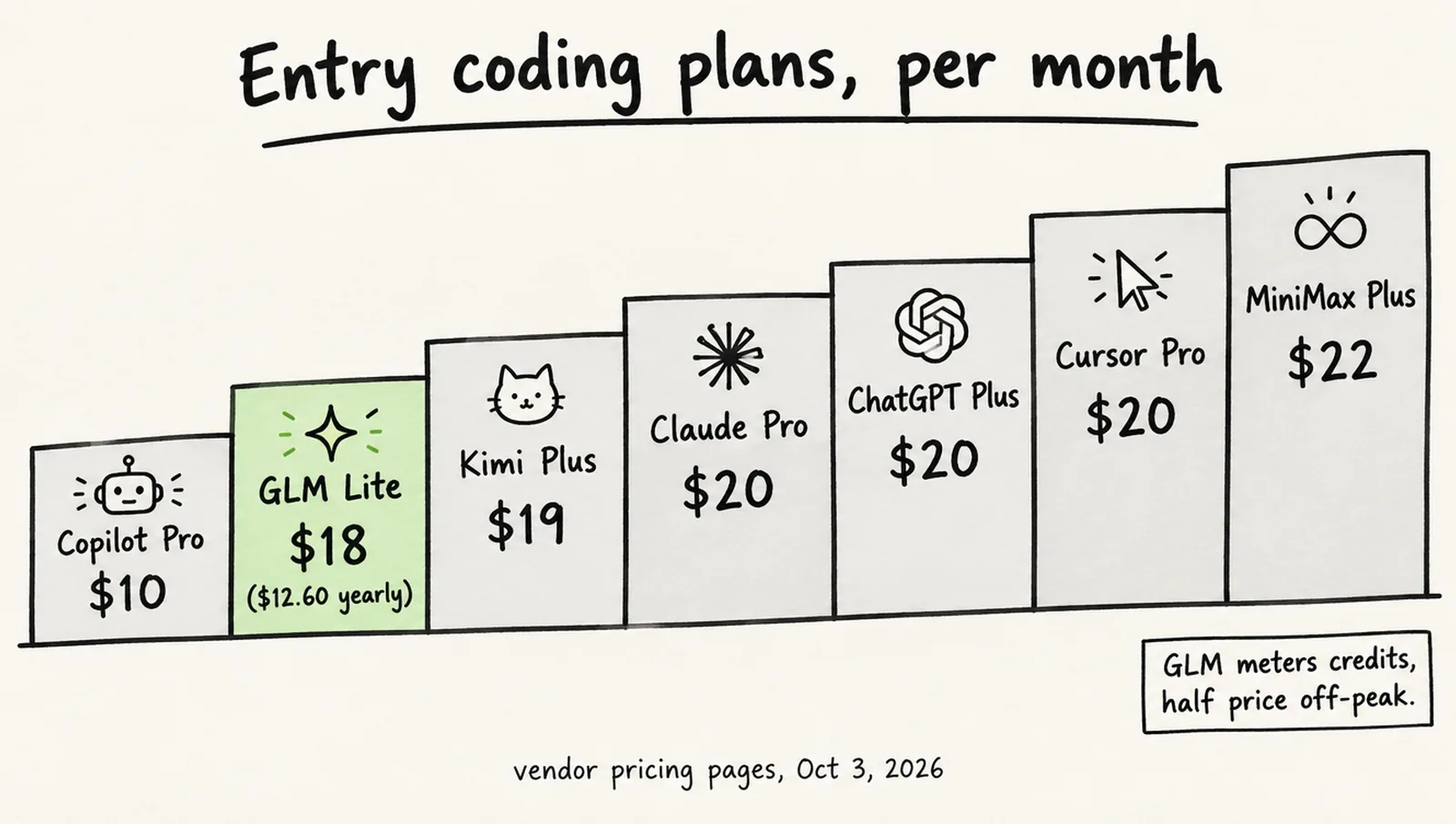
| Price | Lite $18, Pro $80, Max $168 a month; $12.60, $56 and $117.60 a month on yearly billing |
| Quota | 2,000 / 12,000 / 28,000 credits per 5 hours and 10,000 / 60,000 / 140,000 a week; half rate off-peak |
| Peak hours | Monday to Friday 14:00 to 18:00 Singapore time (06:00 to 10:00 UTC, 2 to 6 a.m. US Eastern) |
| Independent rank | Terminal-Bench 4.0: 41.8% (Claude Fable 5.1 57.9%) · Artificial Analysis Index 45 (Claude Opus 5.5 58) · Arena WebDev 20th by score of 138 |
| Speed | 71 tokens a second, 3.2-second time to first token (Artificial Analysis); reviewers call it slow for interactive work |
| Refunds and trial | No trial, no refunds; cancel 24 hours (FAQ) or 3 days (usage policy) before renewal |
| Data terms | Singapore law; individual users’ content may be used to improve services; Team plan excluded from training by default |
| Public rating | Trustpilot 1.9/5 from 39 reviews (66% one-star); G2 seller page could not be opened |
| Best for | Solo developers who run agents daily, mostly off-peak, and keep a frontier model for hard problems |
| Skip if | You need the fastest interactive model, a refund option, or your code cannot leave your jurisdiction |
What is the GLM Coding Plan, and what do you get?
The GLM Coding Plan is a flat-rate subscription that lets coding agents you already use call Z.ai’s GLM models instead of their default model, metered in credits rather than dollars per token. All three tiers include the same two models: GLM-5.3, a text-only model released August 18, 2026 with a 1 million token context, and GLM-5.3-Flash, a smaller multimodal model released August 26. Requests for the older GLM-5.2 and 5.1 are routed to 5.3, and GLM-4.7 to Flash. The tiers differ in credits, in queue priority (“priority access” on Pro, “first access” on Max) and in resources during peak hours, not in models. A plan key works only at Z.ai’s plan endpoints inside officially supported tools; the same key cannot be used for general API calls, and a wrong base URL produces the error “1113 Insufficient Balance” because the request is being billed as API usage you have not paid for. Z.ai has released no new model since August; as of October 3 there is no GLM-5.4 or GLM-6 in its release notes.
How much does the GLM Coding Plan cost in October 2026?
The plan costs $18, $80 or $168 a month, with 20% off quarterly and 30% off yearly billing, and no first-purchase promotion is currently shown. Our GLM Coding Plan pricing guide covers each tier in detail; the table has what matters for a buying decision today.
| Tier | Monthly | Quarterly | Yearly | Credits per 5 hours | Credits per week |
|---|---|---|---|---|---|
| Lite | $18 | $43.20 ($14.40 a month) | $151.20 ($12.60 a month) | 2,000 | 10,000 |
| Pro | $80 | $192 ($64 a month) | $672 ($56 a month) | 12,000 | 60,000 |
| Max | $168 | $403.20 ($134.40 a month) | $1,411.20 ($117.60 a month) | 28,000 | 140,000 |
Three things about the price are easy to get wrong. First, the $3, $15, $72 and $160 figures in many reviews are retired product sets that are still present in the page’s code but “no longer sold.” Second, the subscribe page’s code contains “50% off 1st Month” badges that are switched off, so the only standing discount is 10% on a first order through a referral; the two promotions that are live, all-day off-peak rates and zero-quota GLM-5.3-Flash use from 23:00 to 09:00 Singapore time in ZCode or AutoClaw (double quota in other agents), both end on October 7, 2026, and Z.ai has announced nothing for after that date. Third, there is no trial and no refund: Z.ai’s FAQ says subscriptions “are non-refundable once purchased. Even if you haven’t used your full plan, the fees cannot be returned,” and its two documents disagree on whether you must cancel 24 hours or 3 days before renewal. Treat one month of Lite as the trial.
Affiliate link — we may earn a commission at no extra cost to you.
See GLM Coding Plan tiersHow good is GLM-5.3, according to independent benchmarks?
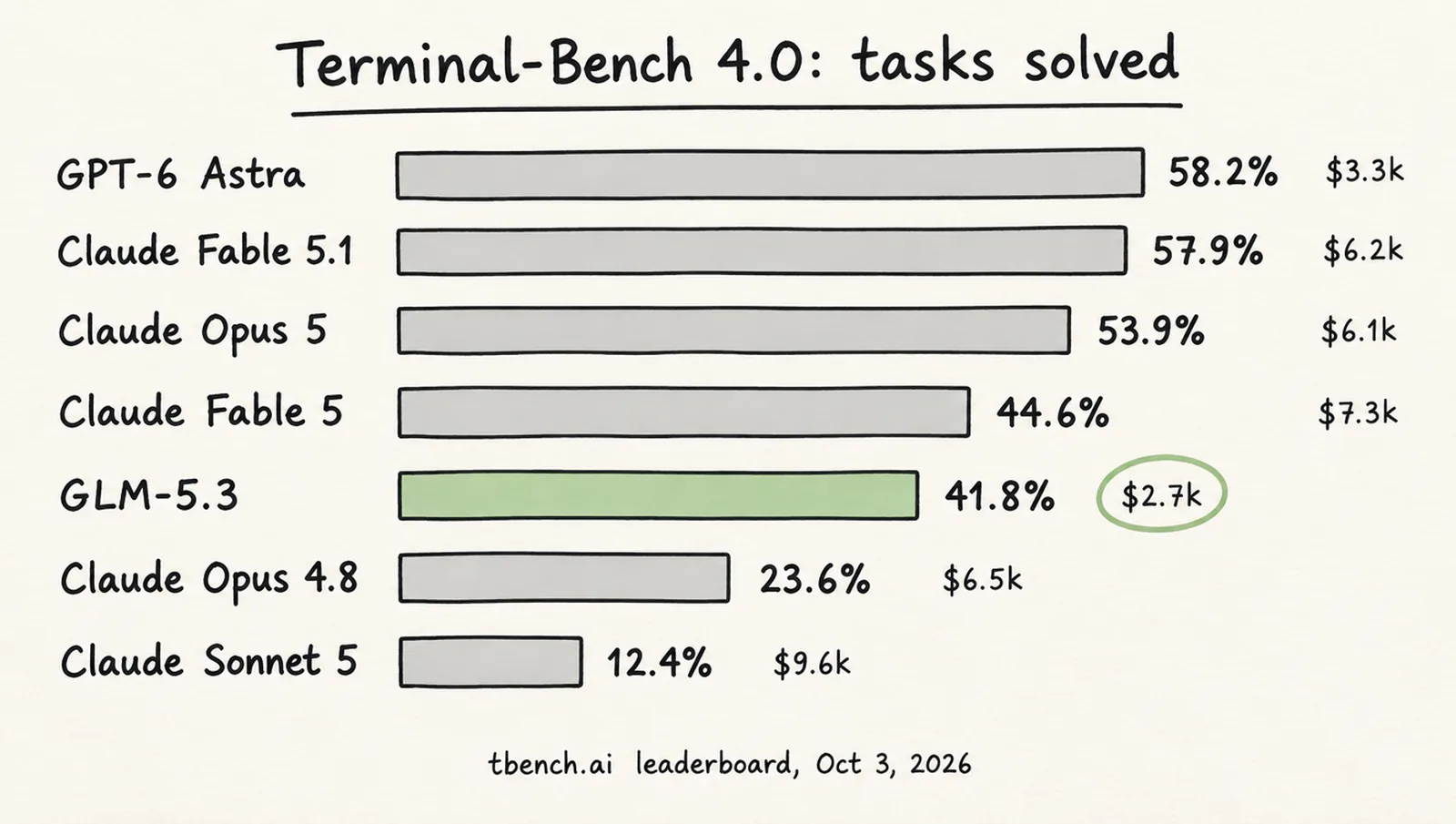
A clear tier below the current Claude and GPT models, and the strongest open-weights option per dollar. The number we weight most is Terminal-Bench 4.0, a leaderboard of agentic terminal tasks run by Stanford, Harbor and the Laude Institute rather than by any model vendor, in which every row is 330 trials, most with a measured cost.
| Model (harness, effort) | Tasks solved | Run cost | Listed |
|---|---|---|---|
| GPT-6 Astra (Codex, max) | 58.2% | $3,300 | September 3, 2026 |
| Claude Fable 5.1 (Claude Code, max) | 57.9% | $6,200 | September 1, 2026 |
| Claude Opus 5 (Claude Code, xhigh) | 53.9% | $6,100 | July 24, 2026 |
| Claude Fable 5 (Claude Code, max) | 44.6% | $7,300 | June 9, 2026 |
| GLM-5.3 (Claude Code, max) | 41.8% ± 3.2 | $2,728 | August 14, 2026 |
| GPT-5.6 Sol (Codex, max) | 37.3% | $2,500 | June 26, 2026 |
| Claude Opus 4.8 (Claude Code, max) | 23.6% | $6,500 | May 28, 2026 |
| Claude Sonnet 5 (Claude Code, max) | 12.4% | $9,600 | June 30, 2026 |
The other independent signals agree on the tier. Artificial Analysis’s Intelligence Index v4.3.2 scores GLM-5.3 at 45, second among open-weights models and level with Qwen3.8 Max, against 58 for Claude Opus 5.5, 56 for Sonnet 5.5 and 53 for Fable 5.1 and GPT-6 Astra; GLM-5.3-Flash scores 42. On Arena’s crowd-voted WebDev board (838,388 votes, snapshot October 1, 2026) GLM-5.3 sits 20th by score (Arena’s own rank range is 15 to 25) of 138 models at 1623, with Claude Opus 5.5 top at 1815. Vals AI’s evaluations, relayed with a September 29 date, put GLM-5.3 at 80.5% on LiveCodeBench (rank 50 of 77) and 44.2% on Code Migration (rank 17 of 56, against 69.8% for Claude Sonnet 5.5). Two cautions: no SWE-bench Verified or SWE-bench Pro score for GLM-5.3 exists on any leaderboard we could open, so ignore the figures circulating for it, and August articles quoting Artificial Analysis scores of 60 and 57 are from an older index version. Z.ai’s own launch table, which shows GLM-5.3 beating Claude Opus 4.8 on its in-house Code Bench while trailing Fable 5, is vendor-run and mixes harnesses across rows; a YouTube tester who scored GLM-5.3 first on his eight-task bench disclosed that Z.ai gave him early access. Neither belongs in the same sentence as the leaderboards above.
How fast is GLM-5.3 in practice?
Slower than its rivals, by measurement and by every hands-on account. Artificial Analysis clocks GLM-5.3 at 71.4 output tokens a second, below the 73.8 median of the models it tracks, with a 3.18-second time to first token it describes as “at the higher end”; GLM-5.3-Flash is slower still at 52.4 tokens a second, which it calls “notably slow.” On Terminal-Bench the average GLM-5.3 trial took 5,831 seconds, about 97 minutes. Reviewers say the same from the keyboard: AI Tool Analysis, citing independent speed tests of the earlier GLM-5.1, called it “among the slowest frontier coding models, noticeably slower than Claude or Grok,” which “stings during interactive work”; the AI Search channel’s YouTube test of an agentic task reported it “took around 53 minutes. It is quite slow” but finished; GLBGPT’s three API-level tasks took 18.7 to 63.4 seconds each once reasoning effort was set to low, and at the default setting the runs used up the output budget and returned no answer. Z.ai publishes no requests-per-minute or concurrency figure for the plan, saying only that limits are “tied to your tier” and “dynamically increased” off-peak. For long autonomous runs the speed matters less; for a chat-style loop it is the first thing you will notice.
How far does the quota go, and when do you hit the limit?
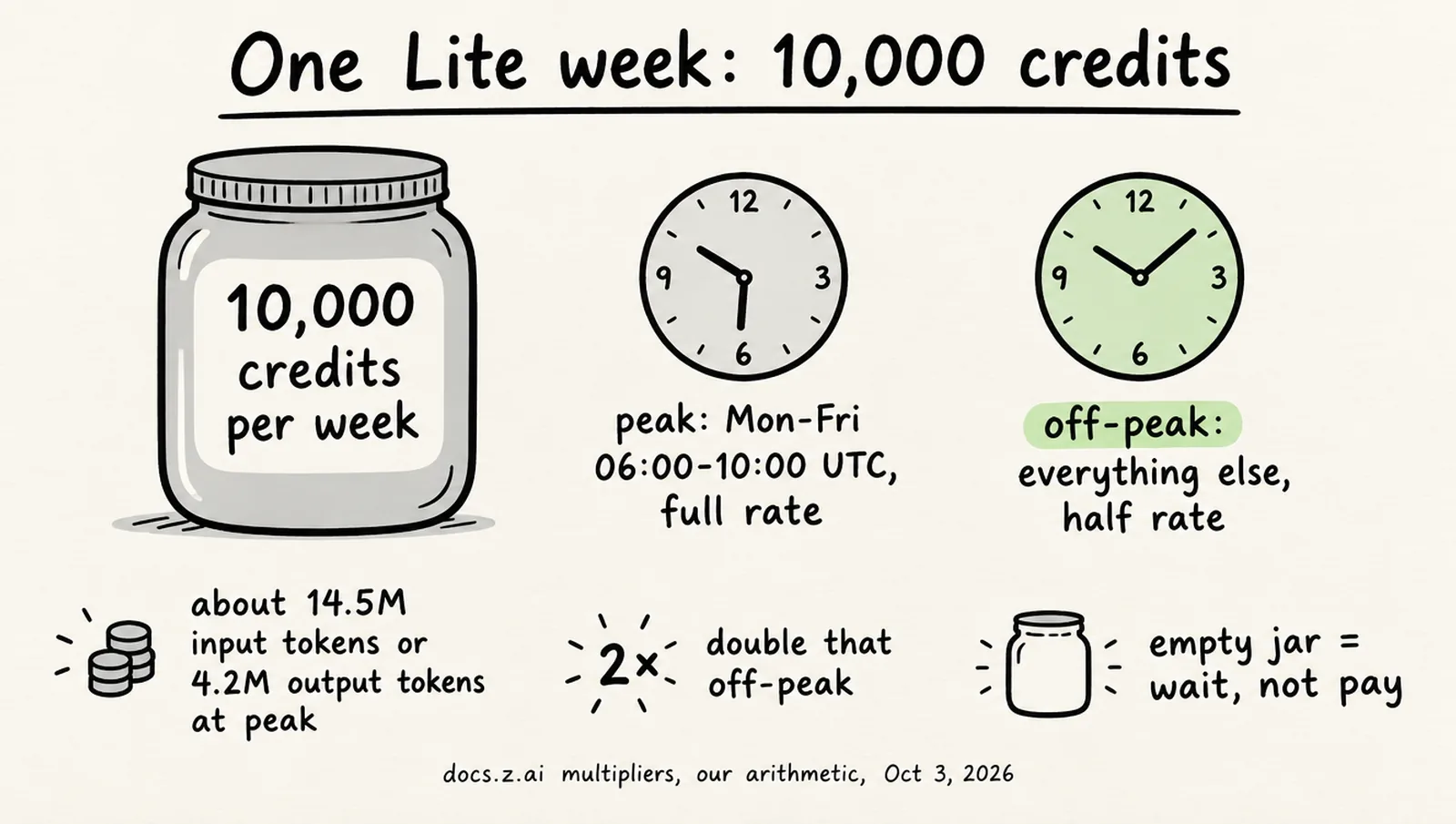
Far enough for a single agent used off-peak, and not far enough for parallel agents at peak, which is the complaint behind most of the negative reviews. Credits are computed per request as input tokens × 6.9, cached input × 1.7 and output × 24, divided by 10,000, for GLM-5.3; Flash is 2.3, 0.56 and 8. Off-peak everything is charged at half rate, and peak is Monday to Friday 14:00 to 18:00 Singapore time, which by our conversion is 06:00 to 10:00 UTC, 2 to 6 a.m. in New York and 7 to 11 a.m. in London. The five-hour window resets five hours after first use; the weekly window starts at purchase; when either is empty you wait, because the plan has no overage and does not touch your card. In token terms, our arithmetic: Lite’s 10,000 weekly credits are about 14.5 million uncached input tokens or 4.2 million output tokens at the peak rate, and double that off-peak. Caching matters: cached input is billed at about a quarter of the uncached rate, and Z.ai’s own weekly estimates assume a 95 to 98% cache-hit rate.
The hands-on record is consistent. A developer who ran Pro in Claude Code for three weeks used about 1,300 of a weekly allowance of roughly 2,000 prompts in normal weeks (the plan was still counted in prompts then) and hit the weekly cap on day five during a heavy migration. On Hacker News one user bought the $18 plan, moved to the $80 plan “almost immediately” and later reported that “2x GLM agents ate 18% of weekly usage on this mid-tier plan within ~8 hrs,” while another said that outside peak hours a single agent does not reach the limits. A security researcher’s report relayed by codepick.dev adds that “peak hour effective limits feel like 60–70% of off-peak” and that the five-hour window “frequently interrupted workflow.” Zentor’s analysis of the complaints puts it well: “people expected throughput and bought a budget.”
Which tools work with the plan, and how do you set it up?
Z.ai lists sixteen supported coding agents and four general agents, and the plan may be used only inside them. The coding list is ZCode (Z.ai’s own agent, charged at 1.5× usage), Claude Code, Claude for IDE, Codex, OpenCode, Pi, Cursor, Cline, TRAE, Qoder, Droid, Kilo Code, Roo Code, Crush, Goose and Eigent; the general-purpose list, served best-effort, is AutoClaw (also 1.5×), OpenClaw, Hermes Agent and SillyTavern. The usage policy adds that use in unsupported tools “may result in restricted benefits” and that accounts with more than three violations of its usage rules may be banned. Setup is a base URL and a key: Claude Code takes an Anthropic-compatible endpoint and model overrides in its settings file, with a helper package Z.ai publishes for the edit; Cline and Cursor use an OpenAI-compatible endpoint with a custom model name; Roo Code, Kilo Code and OpenCode have a built-in “Z AI” or “Z.AI Coding Plan” provider entry. Two details from the docs worth knowing before you start: without explicit overrides, Z.ai’s Claude Code configuration maps the Opus, Sonnet and Haiku slots all to GLM-5.3-Flash, so set the Sonnet and Opus slots to GLM-5.3 yourself; and the 1 million token context is opt-in by adding a suffix to the model name. The Cursor and Cline setup pages still use “GLM-5.2” as their example model, which the docs elsewhere say is routed to 5.3.
What do hands-on reviewers say?
That it is the cheapest coder that is good enough, and that it works best beside a frontier model rather than instead of one. The table summarizes the 2026 reviews whose authors used the plan or model; most quote prices from before the July 30 switch to credits and the current $80 and $168 tiers, so read their numbers as history.
| Reviewer | What they did | Verdict |
|---|---|---|
| techsy.io (July 5, 2026) | Three weeks on Pro in Claude Code on client repositories | A Next.js 16 refactor across “about a dozen files” came “genuinely close to our Claude baseline”; throttling is “a hard stop, not a slowdown”; Pro undercuts Claude Max “on flat-fee cost,” but “GLM cut our bill, it didn’t zero out our Claude dependency” |
| AI Tool Analysis (June 18, 2026) | Daily use in Claude Code; rated 4.3/5 | Reports a community consensus that GLM handles “roughly 90% of everyday coding”; “best run as a second model paired with Claude, not as a full replacement” |
| codepick.dev (August 14, 2026), relaying a Hacker News report | Summarizes a security researcher’s CTF work in the Claude Code harness, as reported on Hacker News | CTF performance “far exceeded expectations” and Pro quota “wasn’t enough” for agent-heavy work, in codepick’s rendering of that user’s report; the user upgraded within a week |
| GLBGPT (August 20, 2026) | Three API-level tasks through a gateway | Worth a trial for frequent agent users; “not the right purchase for someone seeking a fixed, public per-month token number or a no-risk shared team account”; default reasoning effort exhausted the output budget |
| AI Exposé newsletter (August 20, 2026) | Hands-on claimed | “For coding work, it holds up remarkably well”; one prompt can trigger “fifteen to twenty model invocations” |
| AICodeKing, YouTube (August 18, 2026) | ZCode and the plan | “The cheapest good coder right now”; a separate video scoring GLM-5.3 first on his own bench disclosed vendor early access |
| Superbash, YouTube (August 17, 2026) | Built a game in ZCode | Sub-agents produced a working but unsatisfactory result; advises against sub-agents in ZCode |
What do subscribers say?
The public record is small and mostly negative, with a large, engaged Hacker News thread as the exception. Z.ai’s Trustpilot profile scores 1.9 out of 5 from 39 reviews, 66% of them one-star, and is unclaimed; the one-star reviews from August and September 2026 cite quota exhausted without working output, “Currently in peak hours” messages, payment-processing problems, GLM-5.3-Flash underperforming and unresponsive support. G2’s Z.ai seller page could not be opened; third-party reports say it shows no reviews. The GLM-5.3 launch thread on Hacker News drew 1,171 points and 584 comments, and it is where the most useful usage reports live, including the ones quoted above. On Reddit, where we could read only archived titles, the plan’s history shows in thread names: “RIP GLM” (147 points, January 2026), “is glm coding plan still lobotomized?” (April 2026) and “High session usage on GLM Coding Plan with Pi – solution found” (June 2026), alongside the 2025 launch threads for a plan that then cost $3 a month. Support runs through a Discord server; we found no support email, ticket system or status page in Z.ai’s developer documentation.
Where does your code go, and what are the trust questions?
To a Singapore company under Singapore law, under terms that let it use individual users’ content to improve its services. The plan is sold by Jingsheng Hengxing Technology Pte. Ltd., the Z.ai entity named in the privacy policy, which says “We generally provide the Services from Singapore” and that personal data “is generally processed in Singapore.” The Terms of Use, updated April 14, 2026, reserve the right to process individual users’ content “to improve our existing Services and/or to develop new products,” grant Z.ai a perpetual, worldwide license to that content, and exclude enterprise and API customers from improvement use unless they agree. The Team plan states that code and prompts “are excluded from model training by default.” We found no training opt-out for individual Coding Plan subscribers, and no statement of whether a subscriber counts as an individual user or an API customer; the Lite plan card’s “Default data privacy” bullet is not defined anywhere we could find.
Four further items belong in any trust assessment. The US Commerce Department added Beijing Zhipu Huazhang Technology and its aliases to the Entity List on January 16, 2025, with a presumption of denial for exports to them; the listing is still in force, the Singapore seller is not on it, and the rule text addresses exports of items subject to US export rules to the listed entities and says nothing about buying a subscription, so anyone handling export-controlled code should take legal advice rather than our word. In September 2026, after a dispute over data handling in ZCode, Zhipu open-sourced the client under Apache-2.0, removed its repository-wiki feature, and announced a non-retention option for its platform; as of October 3 that option appears in news reports but not in Z.ai’s documentation, and the privacy policy is still dated September 2025. On September 29, 2026 Anthropic, a competitor, published research reporting that GLM-5.3 built end-to-end exploits in 50 of 410 attempts and that its safeguards could be bypassed with simple techniques; the US Center for AI Standards and Innovation is quoted calling it “the most cyber-capable open-weight model released to date.” That is a statement about the model’s capability, not about the plan, and we could not verify a response from Z.ai. Payments go through Stripe by card or PayPal.
If you subscribe, three settings to change on day one
Map the Sonnet and Opus slots in Claude Code to GLM-5.3 rather than leaving the default Flash mapping; set reasoning effort below the default for interactive work, as GLBGPT found necessary in its API tests; and schedule long autonomous runs outside 06:00 to 10:00 UTC on weekdays, where every credit buys twice as much.
Who is the GLM Coding Plan for, and who should skip it?
- Good fit: a solo developer or small team running an agent most days on routine work, in a time zone where the working day falls outside the Singapore afternoon, who keeps Claude or Codex for the hard 10%. This is the setup the longest hands-on reviews landed on, and at $18 or $12.60 a month it is cheaper than a single over-budget API day.
- Good fit: anyone priced out of Claude Max who wants a second, cheaper pool of agent capacity and can tolerate slower responses.
- Poor fit: interactive, chat-style coding where response time is the experience; parallel multi-agent workflows at peak hours on Lite or Pro; and anyone who needs a refund path or a fixed-throughput guarantee, because the plan offers neither.
- Poor fit: work under confidentiality, export or data-residency constraints that cannot be met by a Singapore-law service whose individual-user terms allow improvement use. Compare the data terms in GLM Coding Plan vs Claude Code before deciding.
Verdict: is the GLM Coding Plan worth it?
Yes, as a second model, and the honest version of that sentence has three clauses. GLM-5.3 is good: independent leaderboards place it second among open-weights models and within a tier of last year’s frontier, at a run cost well under half of Claude’s on the same tasks. It is slow and budgeted: 71 tokens a second, a hard stop when credits run out, and peak hours that double the price in the middle of the Asian working day. And it comes with terms that a careful buyer should read: no trial, no refund, a 24-hour-or-3-day cancellation rule Z.ai has not reconciled, and a training clause for individual users with no opt-out we could find. If those three clauses describe a trade you are happy to make, Lite on monthly billing at $18 is the right first purchase, and the yearly price of $12.60 a month is worth taking only after a month confirms the quota fits your week. If any clause is a deal-breaker, the comparison you want is GLM Coding Plan vs Claude Code, which sets this plan against the subscription it is usually bought to supplement.
Frequently asked questions
Is the GLM Coding Plan worth it?
For a solo developer who runs an agent most days, yes at $18 a month, as a second model beside Claude or Codex rather than instead of one. The two multi-week reviews we found, by techsy.io and AI Tool Analysis, reach that verdict. The plan is not worth it if your work needs the fastest interactive responses, if you cannot code outside peak hours, or if you need a refund option: Z.ai sells no trial and refunds nothing.
Can GLM-5.3 replace Claude Code?
It runs inside Claude Code, but it does not match Claude’s models. On the independent Terminal-Bench 4.0 leaderboard GLM-5.3 solves 41.8% of tasks against 57.9% for Claude Fable 5.1 and 53.9% for Claude Opus 5, and Artificial Analysis rates it 45 against 58 for Claude Opus 5.5. Reviewers who used it daily say it handles most routine work and loses on the hardest reasoning and on speed.
Is there a free trial of the GLM Coding Plan?
Not on Z.ai’s official pages. The subscribe page and the ZCode site show no trial, Z.ai’s FAQ says subscriptions are non-refundable even if unused, and a “50% off 1st Month” badge exists in the page’s code but is switched off. The only standing discount is 10% on a first order through a referral. The cheapest way to test it is one month of Lite at $18.
Does Z.ai train on my code?
Z.ai’s Terms of Use, updated April 14, 2026, say it may process individual users’ content “to improve our existing Services and/or to develop new products,” while enterprise and API customers are excluded unless they agree. The Team plan excludes code and prompts from training by default. We found no training opt-out for individual Coding Plan subscribers and no statement of which category they fall into.
Why do you hit limits on the GLM Coding Plan so quickly?
Because an agent spends credits on every token, including the ones it reads back, and peak hours cost double. Lite has 2,000 credits per five hours and 10,000 a week; GLM-5.3 output costs 24 credits per 10,000 tokens at the standard rate. One prompt can trigger fifteen to twenty model calls, and one user on Hacker News reported two parallel agents using 18% of a Pro week in about eight hours. Off-peak use halves the rate.
Is it legal for US users to subscribe to the GLM Coding Plan?
The plan is sold by a Singapore company, Jingsheng Hengxing Technology, which is not on the US Entity List; Zhipu’s entities in Beijing and other Chinese cities have been listed since January 16, 2025. The listing restricts exports of items subject to US export rules to the listed entities and says nothing about buying a subscription. If you handle export-controlled code or data, get legal advice before sending it to any hosted model.
Sources
Prices and plan details were checked against these pages on . Vendors change pricing often, so confirm on the official page before you buy.
- Z.ai — GLM Coding Plan subscribe page
- ZCode — landing page (per-month prices on yearly billing)
- Z.ai docs — GLM Coding Plan overview (credits, multipliers, peak hours, promotions)
- Z.ai docs — latest models in the plan (GLM-5.3, GLM-5.3-Flash)
- Z.ai docs — release notes
- Z.ai docs — GLM-5.3-Flash usage campaign (ends October 7, 2026)
- Z.ai docs — credit campaign rules (referral discount, Stripe)
- Z.ai docs — Coding Plan FAQ (refunds, 24-hour cancellation, payment order)
- Z.ai docs — usage policy (supported tools, 3-day cancellation, concurrency)
- Z.ai docs — Team plan
- Z.ai docs — supported tools
- Z.ai docs — Claude Code setup
- Z.ai docs — context caching
- Z.ai docs — API pricing
- Z.ai — Terms of Use (updated April 14, 2026)
- Z.ai — Privacy Policy (updated September 29, 2025)
- Terminal-Bench 4.0 leaderboard
- Artificial Analysis — GLM-5.3 model page
- Artificial Analysis — models leaderboard (Intelligence Index v4.3.2)
- Arena — Code Arena WebDev leaderboard
- Gradually — GLM-5.3 evaluation summary (Vals AI data, September 29, 2026)
- Anthropic — GLM-5.3 and the spread of advanced cyber capabilities (September 29, 2026)
- Federal Register — Entity List additions, January 16, 2025 (90 FR 4617)
- eCFR — Supplement No. 4 to Part 744 (current Entity List)
- TechNode — Zhipu open-sources ZCode after data dispute (September 21, 2026)
- GitHub — zai-org/ZCode
- techsy.io — GLM Coding Plan, three weeks on Pro in Claude Code (July 5, 2026)
- AI Tool Analysis — GLM Coding Plan review (June 18, 2026)
- codepick.dev — GLM-5.3 Coding Plan review (August 14, 2026)
- GLBGPT — GLM Coding Plan review (August 20, 2026)
- AI Exposé — Z.ai review 2026 (August 20, 2026)
- AICodeKing — GLM-5.3 + ZCode video (August 18, 2026)
- AICodeKing — GLM-5.3 fully tested, early access disclosed (August 13, 2026)
- AI Search — GLM-5.3 agentic test video (August 16, 2026)
- Superbash — GLM 5.3 review in ZCode (August 17, 2026)
- Hacker News — GLM-5.3 launch thread (August 15, 2026)
- Zentor — why you hit rate limits on the GLM Coding Plan (August 14, 2026)
- Trustpilot — Z.ai
- Claude — pricing
- ChatGPT — pricing (Codex limits)
- GitHub Copilot — plans
- Cursor — pricing
- Kimi — membership pricing
- MiniMax — Token Plan pricing