AI App Builders · Comparison · Updated
Emergent vs Lovable (2026): Pricing, Mobile Apps, Hosting and Which AI App Builder to Choose
By KGen Research · Published · 13 min read · Some links are affiliate links; we may earn a commission at no extra cost to you. Disclosure
Short answer
Choose Lovable for a web app: it rates 4.2 on Trustpilot against Emergent’s 2.8, includes unlimited team members, and its credits appear to buy more work each, from $25 a month. Choose Emergent for a native iOS or Android app: it builds Expo apps that can share one backend with a web app, from $20 a month, with hosting from 50 credits per live app.
How we researched this
This is a research guide, not a hands-on test. Prices, limits and rules come from Emergent’s and Lovable’s pricing pages, help centers, documentation and terms, read on October 5, 2026. Credit costs per task come from Lovable’s own examples and, for Emergent, from a 2026 review by the agency Hackceleration, because Emergent publishes no per-task figures. Dollar conversions are our arithmetic. We earn a commission if you subscribe to Emergent through our link. Lovable declined our affiliate application, so we earn nothing from it.
Emergent vs Lovable at a glance
| Emergent | Lovable | |
|---|---|---|
| Builds | Web apps and native iOS and Android apps (Expo) | Web apps; mobile only as a PWA or a wrapper you make |
| Entry paid plan | Standard, $20 a month or $17 billed annually, 100 credits | Pro, $25 a month or $21 billed annually, 100 credits plus 5 a day |
| Free plan | 10 credits a month; no deploys; non-commercial use only | 5 credits a day, up to 30 a month; can publish |
| Hosting a live app | Fixed fee from 50 credits a month (about $10) | By usage after a 20-credit monthly grant; idle apps pause |
| Credit rollover | Plan credits no; top-ups never expire | Plan credits yes; top-ups expire after 12 months |
| Stack | React or Next.js, FastAPI, MongoDB | TanStack Start or React, PostgreSQL on Lovable Cloud or Supabase |
| Git | GitHub from Standard; can pull an existing repo | Git sync on every plan; new repos only |
| Team members | 1 on Free, Standard and Pro | Unlimited on every plan |
| Choose the AI model | Yes, per project | Not for building; yes for AI features in your app |
| Trustpilot | 2.8 / 5 from 636 reviews | 4.2 / 5 from 1,763 reviews |
What is the difference between Emergent and Lovable?
Both turn a description into a working app with a backend, and they are aimed at different finished products. Lovable builds web applications on a fixed stack it chooses, PostgreSQL through its own Supabase-based Lovable Cloud, and its documentation says plainly that it “does not generate React Native projects.” Emergent builds web apps on React, FastAPI and MongoDB and, on paid plans, native iOS and Android apps with Expo, and it can convert one into the other while keeping a single backend. The companies are also different sizes: Lovable raised $400 million at a $13.3 billion valuation in August 2026, while Emergent reached a $1.5 billion valuation in July 2026 and said in September that it runs at about $120 million a year. Emergent’s CEO said in September 2026 that the company is “slowly expanding into becoming an operating system for small businesses.”
How do Emergent and Lovable prices compare?
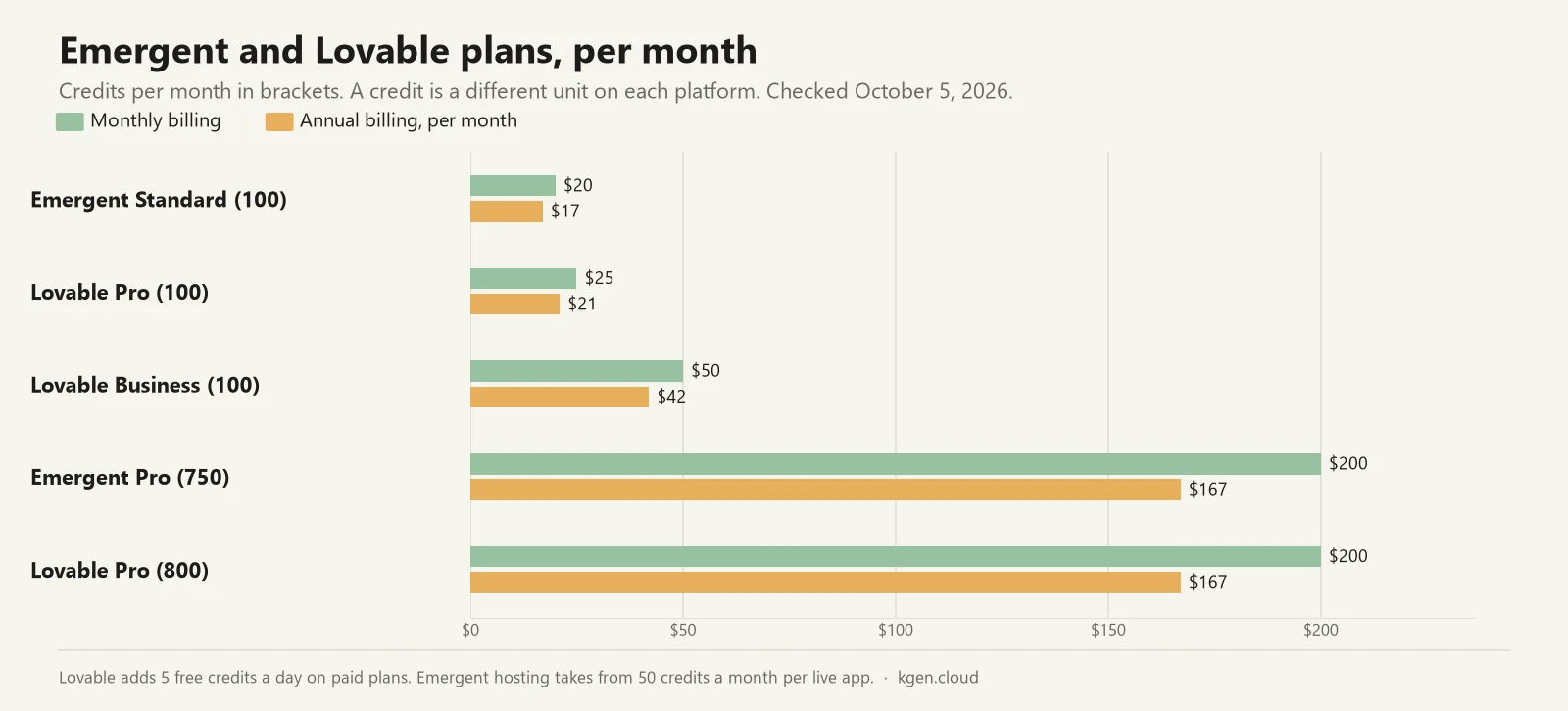
Emergent is cheaper at entry level, $20 against $25 for 100 credits, and on top-ups; at $200 a month the two cost the same and Lovable Pro gives 800 credits to Emergent Pro’s 750. The stickers are also the least useful part of the comparison. Emergent sells three self-serve plans, Free, Standard and Pro, plus custom Business and Enterprise plans. Lovable sells Pro and Business in credit tiers from 100 to 10,000 a month, with every tier including unlimited members.
| Plan | Monthly billing | Annual billing (per month) | Credits | Top-ups |
|---|---|---|---|---|
| Emergent Free | $0 | — | 10 a month | Not available |
| Emergent Standard | $20 | $17 | 100 a month | From $20 per 100; bulk from $500 for 3,000; never expire |
| Emergent Pro | $200 | $167 | 750 a month | From $20 per 100; bulk from $500 for 3,000; never expire |
| Lovable Free | $0 | — | 5 a day, up to 30 a month | Not available |
| Lovable Pro (100 credits) | $25 | $21 | 100 a month plus 5 a day | $15 per 50; last 12 months |
| Lovable Business (100 credits) | $50 | $42 | 100 a month plus 5 a day | $30 per 50; last 12 months |
Per credit, Emergent Standard works out to $0.20 and Lovable Pro to $0.25, before Lovable’s 5 daily credits, which add up to about 150 a month for someone who builds every day; top-ups are $0.20 on Emergent and $0.30 on Lovable Pro, by our arithmetic. Emergent’s Pro plan costs more per credit than its Standard plan, about $0.27 against $0.20 on monthly billing; what Pro adds is a 1 million token context window, custom agents, a bigger machine and bring-your-own MongoDB. Lovable’s price per credit is flat up to 800 credits, then falls to about $0.225 on Pro at the top tiers, by our arithmetic. Lovable’s pricing page notes that daily credits are capped at 30 a month on some regional plans, and students and teachers get 50% off Pro’s 100-credit tier for up to 12 months.
What does a credit buy, and what happens when they run out?
On the figures available, a Lovable credit buys several times more work than an Emergent credit, which reverses the sticker comparison. Lovable publishes examples: “Add authentication” costs 1.20 credits and “Build a landing page with images” 2.00. Emergent publishes none, saying only that a prompt can use “anywhere from a handful of credits … to hundreds.” The agency Hackceleration, reviewing each product separately in 2026, measured 10 to 20 Emergent credits for a landing page with a form and 25 to 40 for user authentication, against 1 to 2 Lovable credits for simple interface changes and 5 to 10 for complex features such as an authentication flow. Those figures come from different apps, so they do not give a precise exchange rate, but the gap is too large to ignore. Emergent’s terms say credits are spent “regardless of the outcome, including where the Output is erroneous.” Lovable gives every account 10 free “Try to fix” fixes, each available again 24 hours after use, before fixes count as normal usage.
Running out works differently on each. On Lovable, building stops, AI features inside your app stop, and the built-in database, storage and sign-in “pause shortly after you run out of credits,” while the published site’s pages keep serving. On Emergent you can still open and hand-edit your code, but cannot generate, test or deploy, and an operation that runs out midway pauses until you add credits. Unused plan credits roll over on Lovable, expiring two months after issue on monthly billing, and do not roll over on Emergent, where only top-ups carry forward, and they never expire. Emergent does not say what happens to a live app when your balance can no longer cover its monthly hosting fee; its help center says only that a deployment stays active while the account holds 50 credits.
How much does it cost to keep an app live?
Emergent charges a fixed fee per live app; Lovable charges by use. Emergent’s help center sets hosting at “50 credits/month per deployed app,” about $10 at Standard’s price per credit and half of Standard’s monthly allowance, taken from the same balance you build with. Its newer documentation describes publishing tiers from 50 to 1,100 credits a month, up to about $220 by our arithmetic, without publishing which tier an app needs. Emergent also says a deployment “will stay active as long as the user has 50 credits in their account even if they cancel the subscription.” Lovable publishes to a lovable.app address for free on every plan and meters its Cloud backend, database, storage and compute against the same credit balance after a 20-credit monthly grant, which Lovable calls a “temporary offering, subject to change.” It pauses inactive projects automatically, though storage is still billed while they are paused, and it shows estimated monthly costs only inside the app, not as a public rate card. Emergent’s documentation adds two production cautions: apps share database clusters, and Emergent “will temporarily block deployments” if an app uses too many shared resources; and “Heavy libraries that work in preview may fail in production.”
Budget for both meters
On Emergent, one live app on the base hosting tier takes half of the Standard plan’s 100 monthly credits before you build anything. On Lovable, a busy app’s backend draws on the same credits you build with. Check the hosting line on either platform before you assume the plan price is the monthly cost.
Which one builds apps for the App Store and Google Play?
Emergent. Its Mobile Agent, on Standard and above, generates iOS and Android apps from one codebase with Expo and React Native, backed by FastAPI and MongoDB. Its documented route to the stores is to download the project and run Expo’s EAS build and submit tools, which build iOS apps in the cloud so no Mac is needed, using an Expo account (free for 30 builds a month) and your own Apple developer account ($99 a year) and Google Play account ($25 once). A one-click conversion turns a deployed web app into a mobile app, or the reverse, sharing one backend, database and sign-in; it costs credits like a normal build, by default takes over the original app’s live address, and the shared backend cannot be split apart later. Lovable’s documentation is direct: it builds web applications, and “there isn’t a built-in flow that packages and submits your project to the App Store or Google Play.” Its routes are a Progressive Web App or a Capacitor wrapper you build outside Lovable. One caution on Emergent: a TechCrunch report in February 2026 described publishing to the stores directly from Emergent’s own phone app, but that app is not listed in the US App Store or Google Play today, and Emergent’s documentation describes the do-it-yourself route.
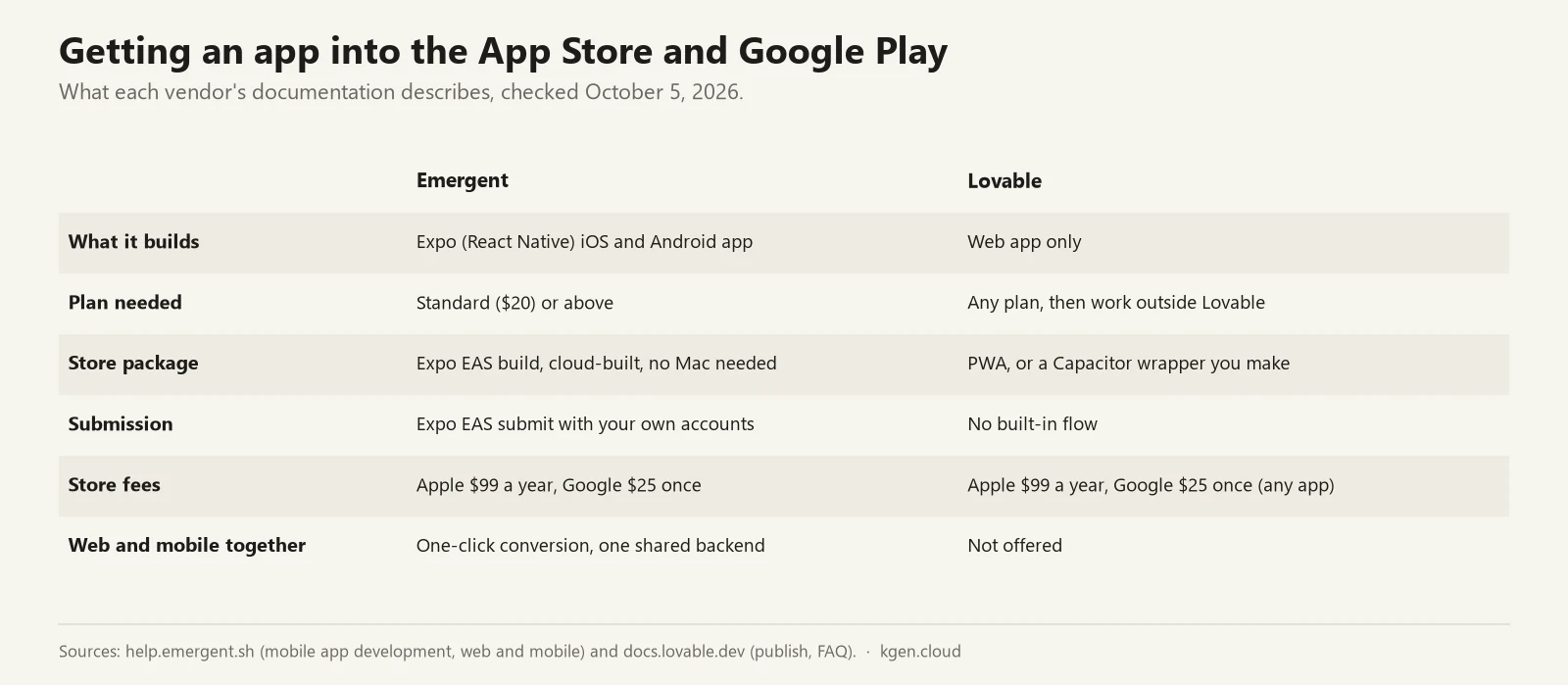
Emergent’s Mobile Agent and deployments need the $20 Standard plan; the free plan’s 10 credits a month let you try the builder, though Hackceleration found them “barely enough to test.” Affiliate link: we may earn a commission at no extra cost to you.
See Emergent plansWhat stack do they use, and can you take your app elsewhere?
Both say you own what you build, and leaving is easier from Lovable. Emergent’s terms state “You retain all ownership rights to code created using our Services.” Lovable says “Your apps, code, and the content you create with Lovable are yours.” Lovable syncs two ways with GitHub, GitLab or Bitbucket on every plan, including Free, and documents how to move the backend to your own Supabase project and leave entirely; its limits are that it cannot start from an existing repository and does not offer a choice of framework or database. Emergent’s GitHub integration starts on Standard and can both push to a repository and pull an existing one into a task. Its apps run on Emergent’s managed MongoDB; moving to your own MongoDB Atlas cluster is a Pro feature that needs an M10 cluster or larger. The two databases are different families, MongoDB against PostgreSQL, so moving an app between these builders means a data-model change, not a new host.
Which free plan lets you ship something?
Lovable’s. Its free plan gives 5 credits a day, up to 30 a month, and can publish to a lovable.app address with Git sync included. Emergent’s free plan gives 10 credits a month and cannot deploy, connect GitHub or use the Mobile Agent, and Emergent’s terms limit it to “personal, non-commercial purposes.” Emergent’s free plan is a way to look at the builder; Lovable’s is a way to launch a small project.
Which is better for teams and for choosing the AI model?
Lovable for teams and compliance paperwork, Emergent for control over the model. Lovable holds SOC 2 Type II, ISO 27001:2022 and AIUC-1 certifications and says it is not HIPAA-compliant; Emergent’s privacy notice claims annual SOC 2 Type II audits. Lovable includes unlimited workspace members on every plan, all drawing on one credit pool, with per-member limits on paid plans and roles from Pro. Emergent’s Free, Standard and Pro plans each have one team member; its own help center says its Projects feature is “designed for solo builders in the current release,” and shared workspaces with real-time co-editing are on its custom-priced Business plan. On the other side, Emergent lets you pick the model per project, for example Claude Sonnet 5.5 or Opus 5.5, and offers a 1 million token context window on Pro; Lovable chooses the model for building and says “you cannot pick a specific model for building,” though you can choose the model for AI features inside your own app.
Do Emergent and Lovable train on your code?
Lovable may, unless you opt out; Emergent’s own documents disagree. Lovable’s documentation says that “as of September 9, 2026, Lovable may use customer data from Free and Pro plans … to train, develop, and improve its AI models … unless you opt out,” with a free toggle under Account settings, Preferences, AI model training that works going forward; Business and Enterprise data is excluded by default, and data from your apps’ end users is not used. Emergent’s privacy notice says “We do not use your prompts, your code or anything else you put on the Platform to train general purpose AI models without your permission,” while its terms of service say “By default, we may use your Content, including your code, to develop and train artificial intelligence and machine learning models,” with an opt-out for future use. Emergent’s docs and help FAQ also say code is not used for training. Until Emergent reconciles its documents, treat the privacy notice’s no-training promise as unconfirmed and opt out where you can. Neither offers refunds as a rule: Lovable refunds only where the law requires, and Emergent’s terms say payments are “non-refundable unless otherwise determined by us,” in a refund clause whose contact still reads “[insert email id/ details to claim refund].” Emergent’s privacy notice also says “the price you are offered may differ from another user’s.”
What do users say about Emergent and Lovable?
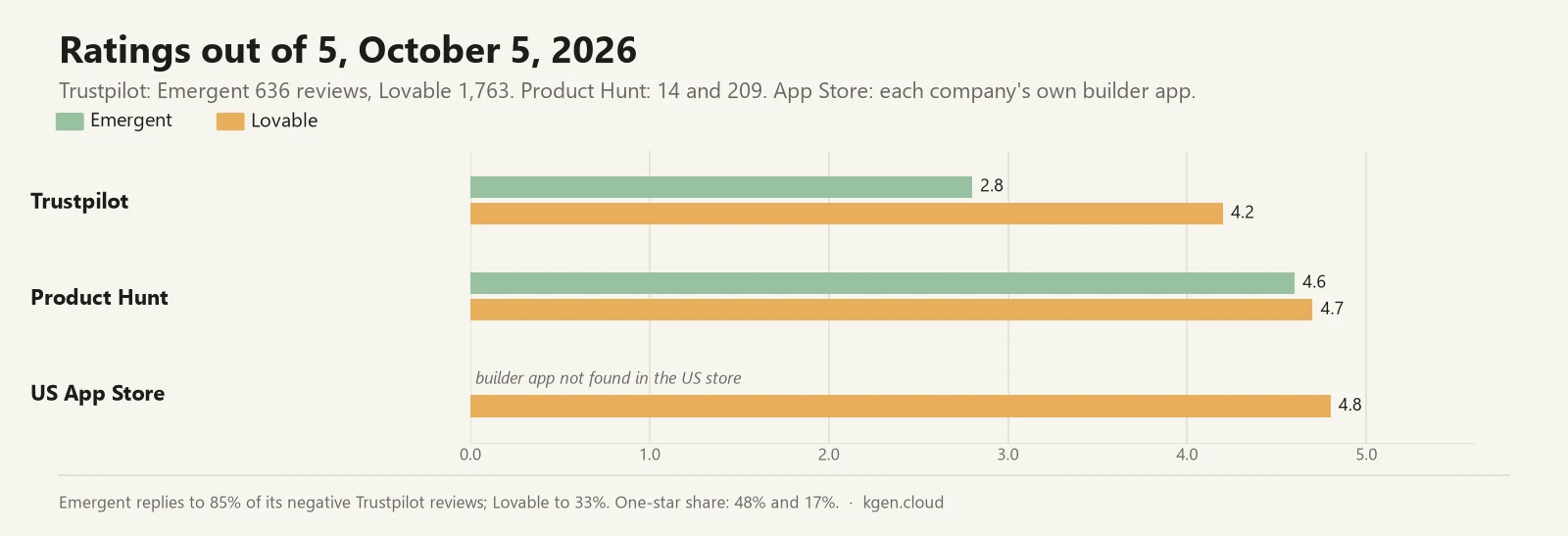
Lovable is rated well above Emergent, and Emergent replies to more of its critics, mostly by pointing them to a form or saying an update was emailed. On Trustpilot on October 5, 2026, Lovable scored 4.2 from 1,763 reviews, 17% of them one-star, and Emergent 2.8 from 636, 48% one-star. Emergent replies to 85% of its negative reviews, Lovable to 33%. Emergent’s low reviews center on credits that run out quickly, often while the agent fixes its own errors, top-up prompts in the middle of a task, edits the agent said it made but did not, and unexpected renewals or plan changes. Lovable’s low reviews center on Cloud usage drawing on build credits since its June 2026 switch to a single credit balance, credits frozen after a downgrade, repeated prompts for the same fix and, in one case, a double charge. On the positive side, recent Lovable reviews praise how quickly non-developers reached a working app, and several recent Emergent reviews thank a named support agent. The agency Hackceleration, reviewing both in 2026, scored Lovable 4.1 out of 5, calling it “one of the most intuitive no-code platforms we’ve encountered” while listing a “credit system unpredictable for budget planning” as a drawback, and scored Emergent 3.4, calling it “genuinely powerful and fast, but its credit-based pricing burns fast and unpredictably.” We found no independent test that built the same app on both.
Verdict: should you choose Emergent or Lovable?
- Choose Lovable for a web app, especially if you are not a developer, work with others, or want an easy path to your own Supabase later. Pro at $25 a month for 100 credits plus 5 a day is the starting point; its free plan is enough to launch a small project first.
- Choose Emergent if the product is a native iOS or Android app, or a web app and a mobile app on one backend, or if you want to choose the AI model or bring an existing repository. Budget Standard at $20 a month; hosting from 50 credits (about $10) a month per live app, taken from your credits and higher on bigger publishing tiers; an Expo account (free for 30 builds a month); and $99 a year to Apple plus $25 once to Google.
- Check the meters before you commit: on the figures available, Emergent’s credits cover less work each, and its plan credits expire monthly; Lovable’s hosting draws on the same balance you build with.
For more builders, see Base44 vs Lovable, the Base44 alternatives guide, which includes Emergent and Replit, or every pairing on our comparisons page.
Frequently asked questions
Is Emergent better than Lovable?
For native iOS and Android apps, yes: Emergent generates Expo (React Native) apps and can turn a web app into a mobile one on the same backend, while Lovable builds web apps only. For web apps, Lovable is the safer choice on the evidence we found: it rates 4.2 on Trustpilot against Emergent's 2.8, includes unlimited team members, and on the figures available its credits buy more work each.
Which is cheaper, Emergent or Lovable?
At entry level, Emergent: Standard is $20 a month for 100 credits against $25 for Lovable Pro with 100, and Emergent top-ups cost $0.20 a credit against $0.30. At $200 a month the two are level and Lovable gives more credits, 800 against 750. The credits are also different units: one agency review measured 5 to 10 Lovable credits for complex features such as an authentication flow, against 25 to 40 Emergent credits for authentication. Emergent also takes hosting from your credits, from 50 a month per live app.
Can Lovable build mobile apps?
Not native ones. Lovable's documentation says it builds web applications and does not generate React Native projects. You can make a Lovable app installable as a Progressive Web App, or wrap its published address in Capacitor outside Lovable and submit that to the stores yourself. Lovable has no built-in flow for packaging or submitting to the App Store or Google Play.
Does Emergent publish my app to the App Store for me?
Its documentation describes doing it yourself: download the Expo project, then build and submit it with Expo's EAS tools using your own Apple developer account ($99 a year) and Google Play account ($25 once). A February 2026 TechCrunch report said users could publish directly to the stores from Emergent's app, but that app is not listed in the US stores today.
Who owns the code I build on Emergent or Lovable?
You do on both. Emergent's terms say you retain all ownership rights to code created with its services and place no restrictions on its use. Lovable says your apps, code and content are yours. Getting the code out differs: Lovable syncs to Git on every plan, Emergent from its $20 Standard plan, and only Emergent can pull in an existing repository.
Emergent vs Lovable vs Replit: which should I pick?
Pick by what you are shipping. Emergent for a native mobile app, Lovable for a web app built by a non-developer or a team, and Replit, which our Base44 alternatives guide describes as a full coding workspace with server-side code and usage-based billing. Our Base44 alternatives guide compares Replit, Lovable and Emergent with five other builders on price and code export.
Sources
Prices and plan details were checked against these pages on . Vendors change pricing often, so confirm on the official page before you buy.
- Emergent — pricing page
- Emergent help — plans and credits (top-ups, hosting fee, zero balance)
- Emergent docs — how credits work
- Emergent docs — put your app live (publishing tiers)
- Emergent help — mobile app development (Expo, EAS build and submit)
- Emergent help — web and mobile conversion
- Emergent help — FAQs (stack)
- Emergent help — deployment information
- Emergent help — GitHub integration
- Emergent help — bring your own MongoDB
- Emergent help — context limits
- Emergent help — Projects (collaboration)
- Emergent — Claude Sonnet 5.5 is now live (model picker)
- Emergent — terms of service (updated August 31, 2026)
- Emergent — privacy notice (updated August 14, 2026)
- Emergent — now a unicorn at a $1.5 billion valuation (July 16, 2026)
- Emergent — CEO on shifting focus to business automation, $120M run rate (September 22, 2026)
- Apple iTunes lookup — Emergent app, US store (no result)
- Google Play — Emergent app listing (not found)
- Apple — Developer Program enrollment ($99 a year)
- Google — Play Console registration fee ($25)
- Lovable — pricing page
- Lovable docs — subscription plans
- Lovable docs — credits and usage (examples, zero balance)
- Lovable docs — project usage (Cloud and AI billing)
- Lovable docs — advanced settings (instances, auto-pause, export)
- Lovable docs — publish (PWA and Capacitor)
- Lovable docs — FAQ (stack, mobile, ownership, model choice)
- Lovable docs — Git sync overview
- Lovable docs — external deployment and hosting
- Lovable docs — data and model training opt-out
- Lovable — terms of service
- Trustpilot — Emergent
- Trustpilot — Lovable
- Product Hunt — Emergent reviews
- Product Hunt — Lovable reviews
- Apple App Store — Lovable
- Hackceleration — Emergent review (agency, 2026)
- Hackceleration — Lovable review (agency, 2026)
- TechCrunch — Emergent hits $100M ARR, rolls out mobile app (February 17, 2026)
- tech.eu — Lovable raises $400M at a $13.3B valuation (August 12, 2026)